Environmental health training and courses
Develop the skills your team needs with expert-led environmental health training. With nearly 140 years of experience, our flexible courses are available online, in person or tailored to your organisation.

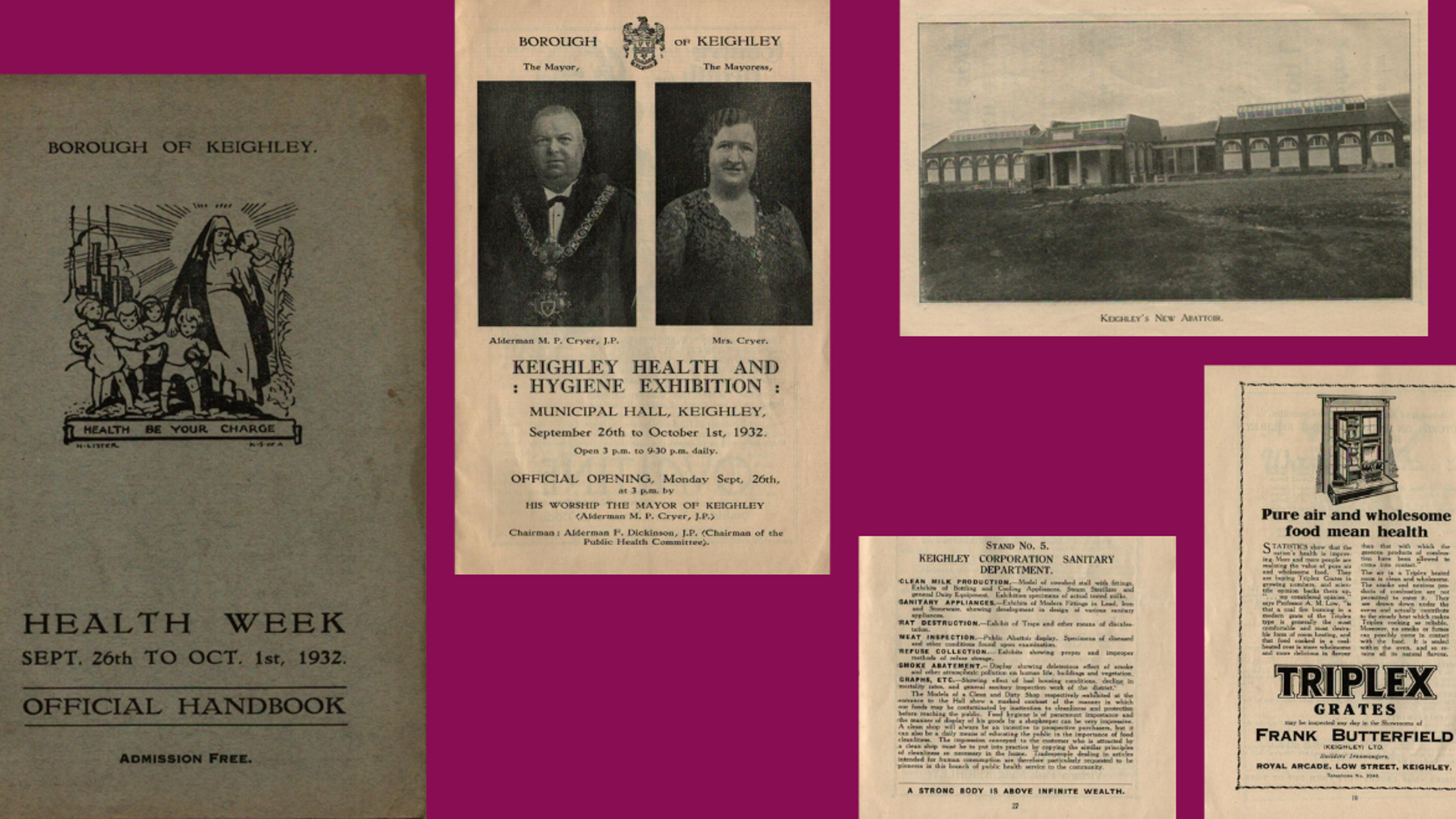
I was delighted to receive the Official Handbook for the Borough of Keighley’s “Health Week” in 1932, thanks to the relatives of a former CIEH member Christopher Wood. Christopher and his team contributed to some of the key aspects of the handbook.
This artefact provides a fascinating insight into the world of Sanitary Inspectors – the Environmental Health Practitioners and Officers of the time. It sheds light on the profile of Environmental Health in the community and council a century ago, with some intriguing resonances for the 2020s.
Keighley is now a civil parish in Bradford, West Yorkshire, but was then its own municipal borough. Health Week appears to have been a well-resourced and multi-faceted collaborative public health campaign. As the foreword by the Medical Officer of Health explains:
“So many problems scintillate in the health of the people that it is the duty of the state to demonstrate their character. Clean water, sunshine, fresh air, pure food, adequate sanitation and good housing are obvious enough. To these may be added other details which the exhibition draws attention to. The importance of infant feeding, the nature and quality of the foods used; heating and lighting; warmth without stuffiness, lighting without glare. Thus it is that science has assisted in placing at our disposal many of the important features essential to the health and well-being of the people. This exhibition will endeavour to show how these inventions have been applied to benefit mankind.”
Health Week included presentations in schools and factories, as well as public lectures and films in the Assembly Hall on topics including “the food value of fruit”, venereal diseases (including the film “How To Tell”, loaned by the British Social Hygiene Council). Keighley’s Chief Sanitary Inspector Mr C.A. Wood gave a talk on “Modern Sanitation” at 8pm on the Thursday.
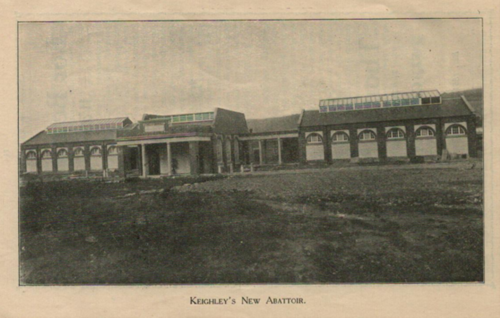
Our colleague Mr Wood was understandably proud of Keighley’s new abattoir, which was open to the public during Health Week:
“There is probably no branch of public health services which has shown greater practical development during the past few years that connected with the demand for a cleaner and more wholesome meat supply. […] Some of the old private slaughterhouses so recently in use, together with the old so-called Westgate Abattoir (now fortunately abolished), were as bad as it was possible to imagine in regard to […] sanitation.
“The real value which the local public obtain is in the knowledge that their meat is slaughtered under the best hygienic conditions in a humane manner, with centralisation making possible an efficient system of inspection. […] Centralisation also tends to uniformity and makes possible the tracing of diseased animals to premises, whereby improvements of milk supply and elimination of disease in stock is possible.”
Unfortunately I have not been able to find any data on how many people visited the new premises, or their impressions of what they saw there.
The exhibition stand by Keighley Corporation Sanitary Department gives us some great insights into the other work undertaken by Mr Wood and his team:
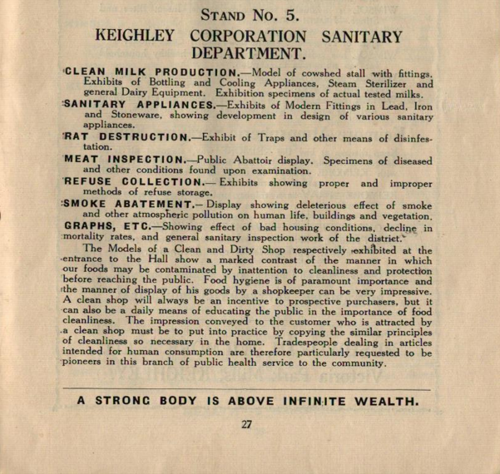
The models of clean and dirty shops speak to a real investment of resources in the campaign and I’m disappointed that I’ve been unable to find a photographic record of them.
Other stands included the Maternity and Child Welfare Department, Dental Board of the United Kingdom, Keighley Industrial Co-Operative Society and the producers of products including Marmite (“the Vitamin B food of many uses”) and Keighmore Atmospheric Spraying Fluid, which was sprayed around the hall “in the public interest” at intervals during the day.
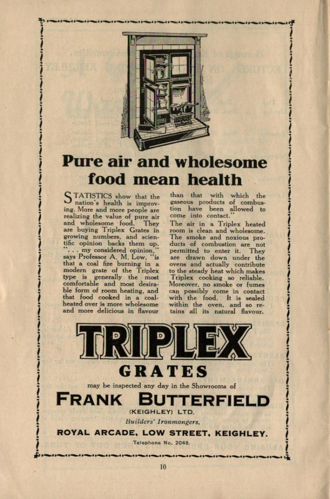
Health Week was an avowedly public-private partnership and the lavish 36 page handbook was paid for by commercial advertising. Some of the claims being made might not make the cut in 2026:
“For better health – Walk on Leather” (Thomas Merrall’s shoe shop)
“Regular Interior Painting and Papering is the surest way to kill germs and make a Healthy Home.” (Hartley Smith decorators)
Wood also contributed an article on “The Evolution of Sanitation” to the handbook, (which brings his total page-count up to five, compared to the Chief Medical Officer’s paltry two pages). I think his words can continue to spur us on as we face the challenges of the 21st Century:
“There is no doubt but that the standard of public health as a result [of legislation] has greatly improved. Even so, the Sanitary Officer of today has to continue in pursuit of those troubles which are the inevitable results of neglect of nature’s simple laws of sanitation. Some people term his enthusiasm as faddism, but having regard to the nature of his enemies “dirt, disease and death” can he not fearlessly meet them with “grit, common sense and grace”? He must keep apace with the evolution of sanitation for there are few individuals who can better influence the environment of the neighbourhood than a conscientious and tactful Inspector.”
The full handbook is now viewable in our digital archive.
Christopher Wood was an Environmental Health Officer between 1918 and 1965, including serving as Chief Public Health Officer in Newcastle-Under-Lyme from 1933 until his retirement in 1965. He died in 1985. We are very grateful to his grandson David Boyd for donating the handbook and other material belonging to Christopher to CIEH.

Environmental health training and courses
Develop the skills your team needs with expert-led environmental health training. With nearly 140 years of experience, our flexible courses are available online, in person or tailored to your organisation.