Environmental health training and courses
Develop the skills your team needs with expert-led environmental health training. With nearly 140 years of experience, our flexible courses are available online, in person or tailored to your organisation.

As temperatures drop and wood-burning stoves are lit, what impact is this having on the air we breathe? To mark Clean Air Night, CIEH Fellow Matthew Clark, a member of CIEH’s Environmental Health Protection Advisory Panel, reflects on the hidden health impacts of wood burning and why more needs to be done to tackle this growing concern.
As the autumn blends into winter, my walk to school with the kids changes with the passing of the seasons. Stepping out of a warm home, the cold air creates a gasp from little faces barely visible under hats and scarves.
Our senses are awakened, accentuating the sight of the vivid colour palette of golds, vibrant oranges and fiery reds that shroud the trees and hedges and the crisp crunch sound of frozen leaves underfoot. Holding hands to steal a bit of warmth from the children’s hot water bottle like hands, we breathe out “smoke”, playing dragons and talk about the snowball fights and snowmen the season ahead might bring.
Sight, sound and touch all notch up good vibes and a playful mood, but then there’s the smell and taste of the air, which changes our conversation. “Urgh, Daddy, very dirty air for our lungs today.” Spot the children of an air quality professional, but they’re right. The all-too-familiar smell of wood smoke lingers long after the cosy orange and red flames of home fires from the night before have gone out, and where you can smell it, the pollution goes hand in hand, as Imperial College London’s research for London boroughs found.
The concerns surrounding domestic solid fuel burning, typically wood burning, are well documented. Domestic burning creates very similar quantities of fine particles (PM2.5) to road transport, according to Defra’s emissions statistics, even though fewer than one in ten homes in towns and cities burn indoors. Unlike road transport, wood burning creates these emissions where people are, within residential areas, meaning exposure to high concentrations before the smoke can is diluted. The most concentrated burning is in urban areas, mainly in more affluent homes that already have another way to heat themselves. This burning is primarily taking place for aesthetic or ambience purposes, not for necessity, according to Defra’s Burning in UK Homes and Gardens research.
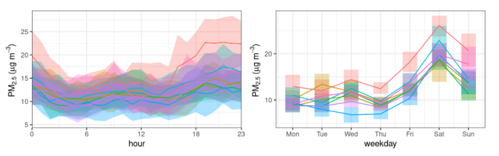
The fact that wood burning creates significant amounts of pollution is no longer in question. Nearly 10% of the annual average PM2.5 concentration in London is from this source and around 50% of PM2.5 monitored in winter can be attributed to this activity. Many examples exist of local monitoring picking up wood burning. The example below shows PM2.5 measurements across several local authority monitoring locations over two counties. It clearly shows increases in the evenings and overnight with higher concentrations at weekends. If we were to overlay nitrogen dioxide, a good indicator of road vehicles pollution, at the same sites we would see a different trend highlighting a different source is responsible for the PM2.5 concentration trends – and a likely candidate is domestic burning.
In short, wood burning creates a large proportion of the country’s fine particulate pollution, and this is done in homes where it is a choice to burn. Yet the health burden of the practice probably sits on a different part of society with fewer means and compounding factors making it more likely for health harms to occur: health inequity in action.
The regulatory regime focuses on reducing emissions from appliances, reducing water content in wood to reduce emissions and regulating the type of fuel that can be used. Smoke control areas can be declared, making it an offence to use more polluting appliances and more polluting fuels, but they form a fragmented and confusing picture. Can I burn or not? What can I burn and in what type of appliance?
The above regime is laudable at face value. However, with an increasing trend of installing appliances and no disincentive in place, the future, particularly in urban spaces, doesn’t look bright. Driving toward ever efficient burning may create even smaller particles, as can be seen with low-smoke fuels or most efficient eco-design stoves. These ultrafine particles (UFPs) penetrate deeper into the lungs resulting in the health impact not being what the rule makers were expecting. A potential example of legislation delivering a target but not the required outcome. Taken more broadly a focus on reducing PM2.5 (by weight) may create the conditions for more UFPs in the atmosphere.
I don’t see the current statute surrounding wood burning creating a significant reduction in particulate exposure. Would we be happy for the same proportion of homes that own a car to be burning wood in future? If we saw an increase to just 50% of homes burning, we would find ourselves back where total UK emission levels are equivalent to that produced in 2005, around 100,000 tonnes and which included coal powered energy production. The worrying change from 2005 would be that the pollution would all be produced within our neighbourhoods, creating greater levels of exposure. Maybe it’s time for a change to the way we regulate this industry? There are tested options available – just look to New Zealand but other processes also exist. Could a polluter pays principal come in like how other polluting practices are regulated and one of the key principals the Environment Agency considers when regulating polluters.
Air pollution continues to be a significant burden on our population’s health, linked to around 30,000 deaths a year in the UK, according to the Royal College of Physicians. For years, calls have been made for a national public campaign on the issue. In 2024 the Clean Air Night campaign came onto the scene to fill part of the void, shining a light on and sharing the truth about wood burning.
Clean Air Night highlights how wood burning creates harm to health, harm to the planet, and hits your wallet. It provides the information people may need to consider before they choose to buy an appliance or set a fire in one that exists. As Clean Air Night takes place again tonight, the campaign is as relevant today as it was three years ago. By creating a consistent set of robust, evidence-based materials, the campaign ensures local authorities and others can be confident that they are providing robust information and that it will be consistently provided up and down the country.
So, where do we need to go to create healthier air for all in future? At the national level, a public campaign on air quality with a wood-burning angle is well overdue, and the regulatory regime needs to change. Locally, leaders need to communicate the issue and promote any opportunities to make it clear wood burning in urban centres is not something we want to see in our future. Leaders at both local and national levels must be fully informed of the challenges, prepared to take decisive action, and have the conviction to look beyond short-term difficulties towards establishing a sustainable long-term position.
I can reduce the impact local wood burning has on my family’s health by knowing when it is happening through air quality monitors in the home and removing the pollution through air cleaning devices, but I am not the norm. It shouldn’t be up to those not conducting the polluting activity to spend their time and effort keeping their homes free from other people’s pollution. At its core, this is a matter of creating a fair society. Wouldn’t it be nice if in future our children get to experience the joy and wonder of a crisp autumn or winter morning and breathe fresh air at the same time?

Environmental health training and courses
Develop the skills your team needs with expert-led environmental health training. With nearly 140 years of experience, our flexible courses are available online, in person or tailored to your organisation.