Environmental health training and courses
Develop the skills your team needs with expert-led environmental health training. With nearly 140 years of experience, our flexible courses are available online, in person or tailored to your organisation.


Providing essential insight into the public health impacts of noise across England and Wales.

Following the publication of the CIEH Data Briefing in March 2026, CIEH has published a major new report, Sound Thinking, warning that noise pollution remains a significant but often overlooked threat to public health and wellbeing, with nearly a quarter of people saying they are regularly disturbed by noise and many believing the problem is getting worse.
The report combines analysis of local authority noise complaint data with new Ipsos polling of more than 2,100 adults aged 16-75 in England and Wales. It highlights the health impacts of environmental noise, identifies emerging sources of noise nuisance and sets out a series of policy recommendations aimed at improving how noise complaints are recorded, monitored and addressed.
According to the Ipsos research commissioned by CIEH:
CIEH believes there is strong public support for making noise complaints easier to report and track. The survey asked respondents what, if anything, would make the reporting process easier for them if they wanted to report noise to their local council. Nearly one-third (32%) of respondents selected "ability to report the noise online" from the options presented, 28% would want "greater confidence that councils would take action". Overall, 59% of adults aged 16-75 surveyed selected answers relating to improving the flexibility and accessibility of reporting systems.
Among the report's key recommendations are calls for:
The report concludes that reducing noise harm will require action on prevention, planning, public health and environmental health, supported by better data and stronger national coordination.
Stakeholder responses to Sound Thinking:
"CIEH’s report tells an important story about the impact excessive noise has on public health and people’s lives. I’m glad this Government is tackling the problem, introducing Respect Orders to give greater powers to tackle the issue and to prevent people causing persistent nuisance in public areas or affecting neighbourhoods but better defining and measuring the issue will still be necessary as this report makes clear."
Neil Coyle MP, Chair of the All-Party Parliamentary Group on Anti-Social Behaviour and Labour MP for Bermondsey and Old Southwark
"The Institute of Acoustics welcomes CIEH’s call for a more consistent approach to the reporting of noise complaint data, recognising that better data, as well as technical expertise and properly resourced environmental health services are essential for the effective management of noise and protecting public health and wellbeing in the longer term from what has been recognised to be a neglected pollutant."
Paul Shields, President of the Institute of Acoustics (IoA)
"The Noise Abatement Society welcomes the new CIEH report "Sound Thinking" which recognises a priority need for better reporting, data collection and understanding around the real-life effects of intrusive noise on communities."
Gloria Elliott OBE, Chief Executive, Noise Abatement Society
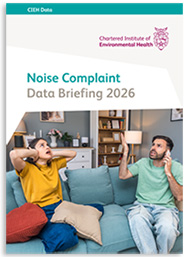
The Noise Complaint Data Briefing 2026 provides the most up-to-date national overview of noise complaints received between 1 October 2024 and 30 September 2025. It is the first dataset of its kind published by CIEH since 2020/2021 and includes several new categories of noise sources, reflecting the changing nature of the built environment and public health needs.
The Noise Complaint Data Briefing 2026 is based on data collected from local authorities between October 2025 and February 2026, covering complaints received from 1 October 2024 to 30 September 2025. With a 92% response rate, it is one of the most representative noise datasets CIEH has produced in recent years.
For the first time, the survey includes complaints about emerging noise sources such as ASHPs and short-term holiday lets.
Last year, fewer than 48% of local authorities responded to the voluntary noise survey, limiting the dataset's usefulness and affecting indicators in the Public Health Outcomes Framework. To improve the quality and consistency of national noise data, CIEH has consulted with UKHSA, DEFRA and other partners, refined the question set with input from Advisory Panels, included new noise sources and moved from a voluntary survey to a consistent FOI-based approach.
CIEH will continue to explore the implications of this year’s findings throughout spring 2026.
Our noise survey provides the only source of regular national information on the important contribution made by EHPs working to resolve noise complaints.
The survey was referenced in the 2017 Chief Medical Officer annual report, which emphasised that "environmental noise comes second in burden of disease to air pollution and arguably is responsible for more disturbance of quality of life". Noise is the single largest issue of complaint made to local authorities in the UK, and over 80% of people report being exposed to noise pollution in their homes.
The 2020/21 England Noise Survey report was published in March 2022.
Key findings:
The report covers:
Responses to the survey were received from all local authorities in Wales.
Key findings:
We collected data from 143 local authorities in England.
The report covers the same areas as the new 2019/20 report excluding other formal actions taken by Local Authorities.
 All 22 local authorities in Wales responded to the survey, which is a response rate of 100%.
In total 18,567 noise complaints were recorded, which works out as 59 complaints for every 10,000 members of population. Noise from residential premises accounts for the largest proportion of noise complaints, while industrial noise accounts for the lowest proportion of noise complaints compared to other sectors.

Environmental health training and courses
Develop the skills your team needs with expert-led environmental health training. With nearly 140 years of experience, our flexible courses are available online, in person or tailored to your organisation.